Systematizing Personality
Systematizing Personality is a long-form philosophical investigation into the nature of personality and meaning. Rather than treating personality as a fixed identity or a collection of measurable traits, the essay argues that personality is better understood as a dynamic "climate" of meaningful experiences, interpretations, actions, and perceptions. Drawing from psychology, semiotics, phenomenology, and philosophy of mind, it critiques popular systems such as IQ, the Big Five, and MBTI before developing an original framework for understanding personality through the interplay of subjectivity, objectivity, and meaning-making.
Summary
The project began with a simple question: what if modern personality psychology has misunderstood what personality actually is? Contemporary systems often assume that personality is an underlying essence that can be measured through traits, surveys, or typologies. In this essay, I challenge that assumption and propose that personality is not an identity hidden behind behavior, but rather a living pattern formed through countless acts of interpretation, decision-making, and engagement with the world. Personality is defined as a person's relationship to meaning.
To build this argument, the essay examines several prominent personality frameworks, including IQ, gender models, the Big Five, and Jungian psychology. Each is analyzed not primarily as a psychological tool, but as a philosophical model that carries hidden assumptions about identity, measurement, and human nature. The discussion focuses on the tension between subjective experience and objective measurement, arguing that many contemporary systems confuse operational definitions with the richer realities they attempt to describe.
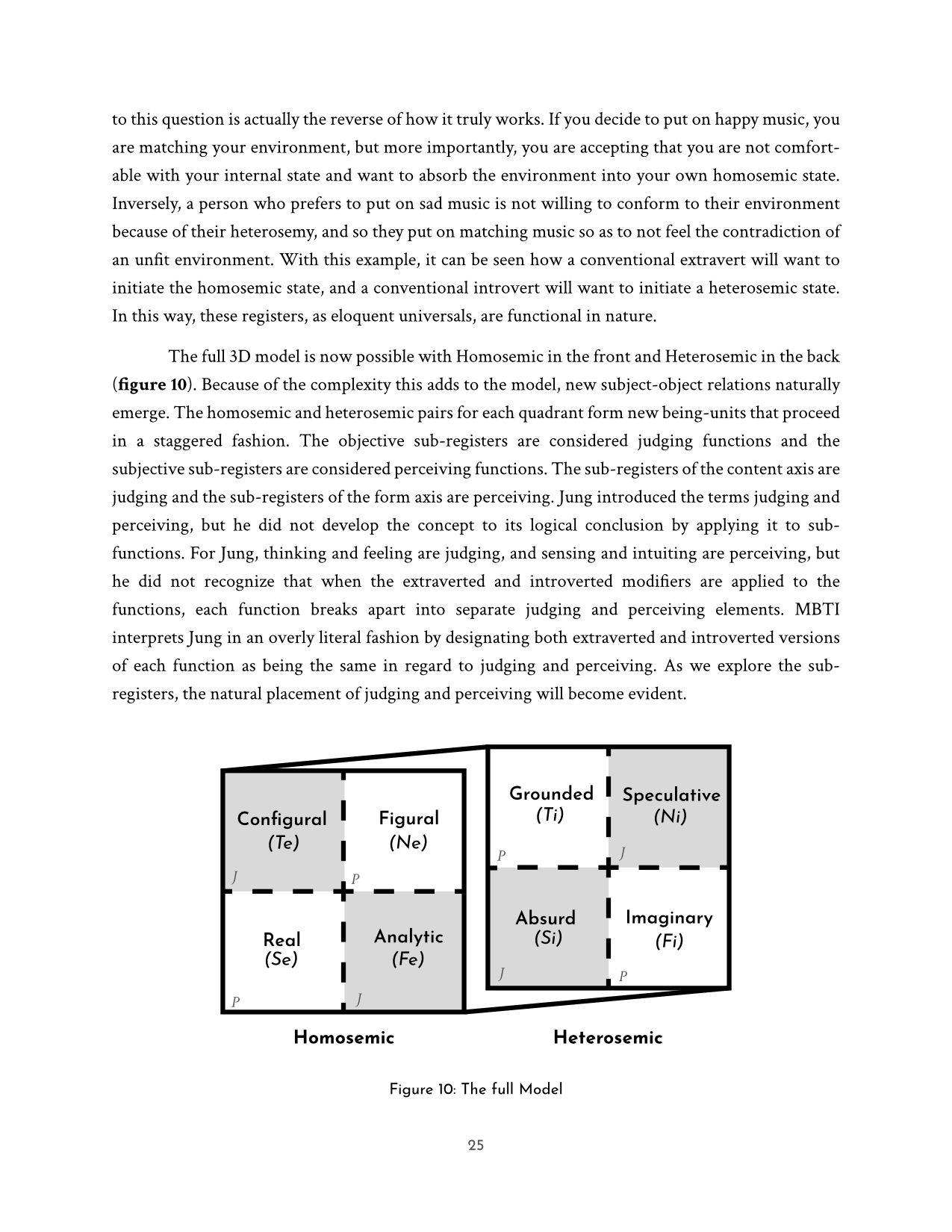
The second half of the essay develops an original theory of personality rooted in semiotics, the study of meaning and signs. Using concepts such as subject and object, symbol and abstraction, and index and icon, I construct a visual framework that maps different modes of interpreting the world. This framework evolves into a multidimensional personality model designed to describe how people generate, process, and organize meaning rather than simply assigning them to static categories. Throughout the project, historical thinkers ranging from Carl Jung, Jacques Lacan, and G. W. F. Hegel to Bertrand Russell, Jean-Paul Sartre, and Plato are used as examples to demonstrate how different intellectual temperaments emerge from distinct relationships to meaning.
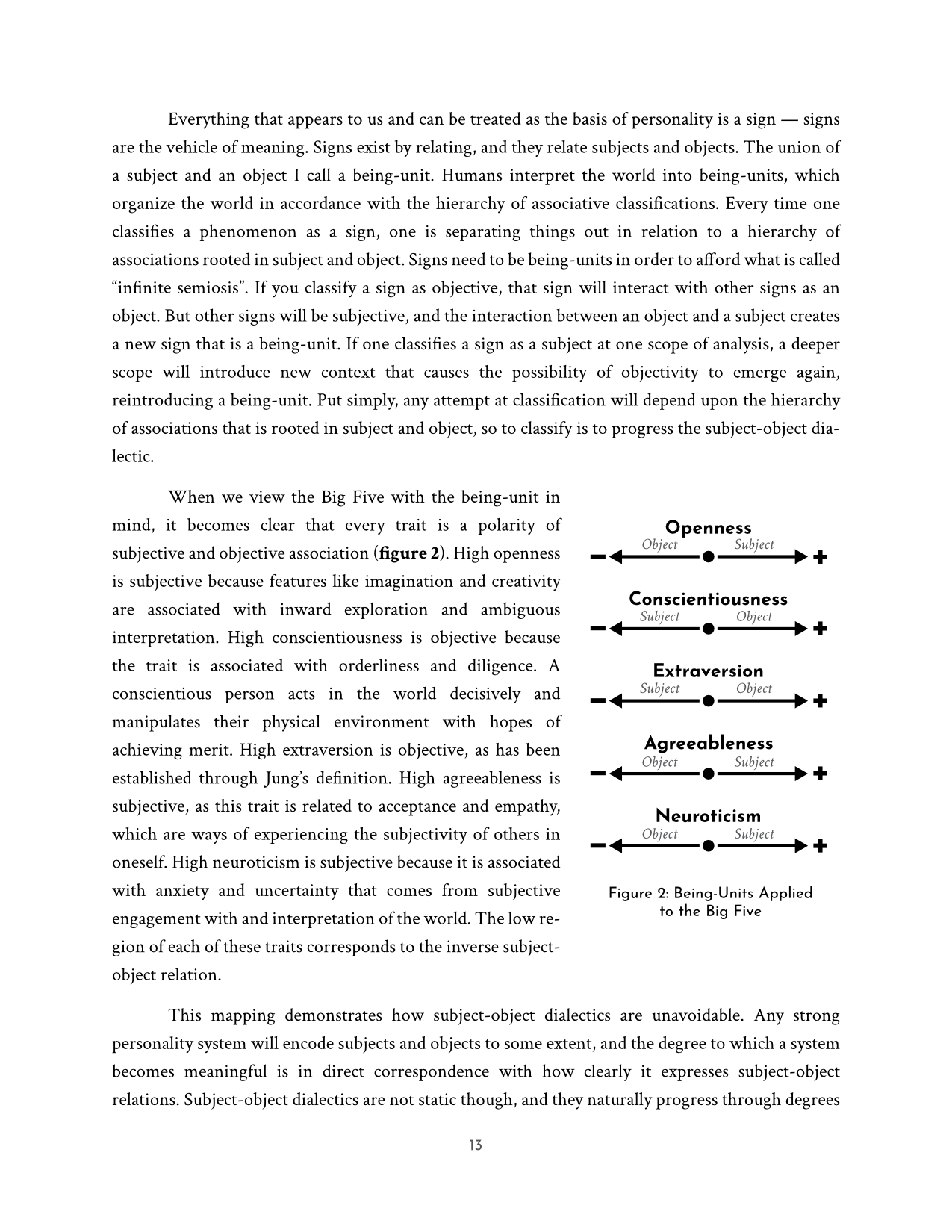
What makes this project unusual is its interdisciplinary approach. The essay combines philosophy, psychology, semiotics, systems thinking, and visual model-building into a unified theoretical framework. While I do not present it as a replacement for empirical psychology, the project demonstrates my interest in creating original conceptual systems, synthesizing ideas across disciplines, and communicating complex abstractions through diagrams and visual structures. Several custom visual models are developed throughout the essay, including the gender semiotic square, a reinterpretation of the Big Five, the Complete Dasein model, and the final personality framework known as the Nein Structure.
PDF Preview
This essay is available as a downloadable PDF here.